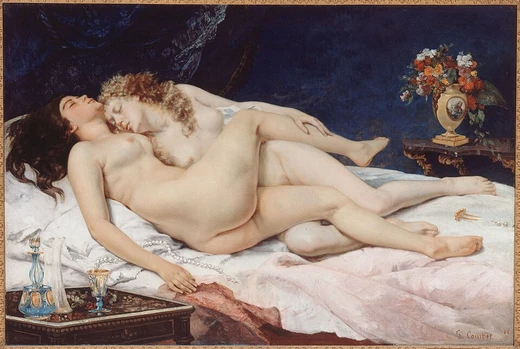
Pansexuality
Attraction to all genders or regardless of gender.

Wikipedia / Wikimedia Commons
Pansexuality refers to sexual, romantic, or emotional attraction to people of any gender, or attraction that occurs regardless of a person’s sex or gender identity. Those who identify as pansexual often describe themselves as gender-blind, meaning that gender and sex do not influence their romantic or sexual interest in others. This orientation is sometimes viewed as a distinct category, while other times it is considered a subset of bisexuality—since attraction to all genders includes attraction to both the same and different genders—and is used to signal a lack of gender preference. Although the term’s etymology explicitly rejects the gender binary, this rejection is not unique to pansexuality and appears in broad definitions of homosexuality, bisexuality, and the asexual spectrum.
The prefix *pan-* comes from the Ancient Greek word for “all” or “every.” Pansexuality is also known as omnisexuality. When a distinction is made, pansexuality emphasizes gender blindness, while omnisexuality highlights the role of gender in attraction; otherwise, the two terms are often treated as synonyms. One of the earliest known uses of “omnisexual” in Portuguese appeared in 1878, when Brazilian writer Machado de Assis—writing under the pseudonym Eleazar—criticized the novel *O Primo de Basílio* by Eça de Queirós, calling its naturalism and lack of sexual restraint “reminiscences and allusions of an eroticism that Proudhon would call omnisexual and omnimod.” Early figures sometimes associated with pansexual tendencies include John Wilmot and Friedrich Schiller. The hybrid words “pansexual” and “pansexualism” were first recorded in 1914 (spelled “pan-sexualism”), coined by critics of Sigmund Freud to describe the idea that sexual instinct drives all human activity. The term was later translated into German as *Pansexualismus* in Freud’s *Group Psychology and the Analysis of the Ego*. By the 1970s, “pansexual” and “omnisexual” were used alongside “bisexual” to describe a variety of attractions. According to *Bi Any Other Name*, pansexual people have been active in bisexual communities since that decade. The term gained traction as a distinct sexual identity in the 1990s, capturing desires that already existed for many. Social psychologist Nikki Hayfield notes early use within BDSM communities. In 2010, the pansexual flag was posted on a Tumblr blog, designed by Jasper Varney
- field
- Sexual orientation and identity
- known_for
- Attraction to people of all genders or regardless of gender; use of the pansexual flag designed by Jasper Varney in 2010
Lore & Background
The prefix pan- comes from the Ancient Greek πᾶν (pan), meaning 'all, every'. Pansexuality is also sometimes called omnisexuality; when a distinction is made, pansexuality emphasizes gender blindness, while omnisexuality emphasizes the role of gender in attraction. In 1878, Brazilian writer Machado de Assis made one of the first known uses of the term omnisexual in Portuguese, criticizing a novel's naturalism as 'omnisexual and omnimod'. Early individuals who displayed pansexual tendencies include John Wilmot and Friedrich Schiller. The hybrid words pansexual and pansexualism were first attested in 1914 (spelled 'pan-sexualism'), coined by opponents of Sigmund Freud to denote the idea that the sex instinct plays a primary part in all human activity. The word pansexual is attested as a term for a variety of attraction by the 1970s, and the term pansexuality emerged as a sexual identity in the 1990s, with early use in BDSM communities. In 2010, the pansexual flag was posted on a Tumblr blog, designed by Jasper Varney, with cyan for attraction to men, pink for attraction to women, and yellow for attraction to non-binary people.
Reader's Guide
Pansexuality holds significance as a sexual identity that explicitly includes attraction to people of all genders, including those outside the gender binary. Its emergence in the 1990s provided a label for desires that already existed, and it has been actively involved in the bisexual community since the 1970s. The term has generated debate regarding its relationship to bisexuality: some argue that bisexuality already encompasses attraction to multiple genders, while others see pansexuality as more inclusive of non-binary and intersex individuals. The American Institute of Bisexuality contends that people who identify as pansexual are also bisexual, as they experience homosexual and heterosexual attractions. Tensions sometimes arise between bisexuals and pansexuals, as pansexuals often see themselves as more inclusive, though a 2022 study found that many women identifying as pansexual or queer defined bisexuality as limited to cisgender men and women. Pansexuality's legacy includes its role in expanding discourse on sexual orientation beyond the gender binary and its representation through symbols like the pansexual flag.
Did You Know?
- The pansexual flag was designed by Jasper Varney and posted on a Tumblr blog in 2010.
- The word pansexualism was first attested in 1914, coined by opponents of Sigmund Freud.
- Machado de Assis used the term omnisexual in an 1878 newspaper review.
- The prefix pan- comes from the Ancient Greek πᾶν (pan), meaning 'all, every'.
Frequently Asked Questions
What is pansexuality?
Pansexuality is a sexual, romantic, or emotional orientation in which a person is attracted to others regardless of the target's sex or gender identity. It is often described as a 'gender-blind' experience where gender simply does not factor into who someone finds appealing.
How does pansexuality differ from bisexuality?
Both orientations involve attraction beyond a single gender, but pansexuality specifically centers on the idea that gender is irrelevant to attraction. Bisexuality is typically framed as attraction to two or more genders, whereas pansexuality signals a complete absence of gender preference.
Who created the pansexual pride flag and when?
Jasper Varney designed the pansexual flag in 2010. It has since become the most widely recognized symbol for the identity within the LGBTQ+ community.
What does 'gender-blind' actually mean in the pansexual context?
It means that a person's romantic or sexual interest is not shaped, filtered, or influenced by the gender or sex of the individual they are drawn to. In practice, a pansexual person may describe their attraction as directed at the person rather than at a gender category.
Is pansexuality a standalone identity or a subset of bisexuality?
The community treats it both ways: some people and organizations list it as its own distinct category, while others classify it as a subset of bisexuality. The distinction often comes down to whether the individual wants to emphasize that gender plays no role in their attraction.
More in Sexual Practices & Identities 1-24
Spotted an error? Know more?
This is a living reference — every entry is fact-audited, and reader corrections feed straight into our audit queue. Suggest an edit · See this site's audit record